

The healthcare industry is moving fast, kind of like digital transformation, automation, and data-based patient care are all piling up at once. Hospitals, clinics, and healthcare orgs are now leaning into customized ERP solutions to keep things moving, help with patient handling, and, generally, boost day-to-day performance across the entire system.
When hospital workflows are still managed manually, it can create operational lags, uneven records, data inconsistencies, billing errors, and, honestly, a not-so-great patient experience. That’s why custom enterprise software development matters; it helps healthcare organizations form centralized but also scalable, customized ERP solutions that fit their specific operational needs, instead of forcing a generic setup.
From patient management and appointment planning, all the way through inventory monitoring and billing automation, healthcare ERP systems are reshaping how modern hospitals run.
Table of Contents
Why Healthcare Organizations Need Custom ERP Solutions
Every healthcare organization has a somewhat unique way of running things, plus distinct compliance rules and patient management workflows. Because of that, generic software packages often just don’t fit quite right, so customized ERP solutions tend to work better for hospitals and other healthcare providers.
A tailored ERP setup can help healthcare businesses do a bunch of things at once, like:
- Bring patient info and daily operational data into one place
- Move paperwork and admin tasks through automation more smoothly
- Strengthen coordination between departments, even when they’re busy
- Cut down on operational errors that quietly add up
- Lift the overall patient experience, not only the paperwork side
- Use staff, beds, and supplies in a more efficient manner
- Meet regulatory compliance needs without constant patching
- Support stronger reporting and analytics for better decisions
When hospitals bring the core parts of healthcare operations into one platform, they can boost efficiency while still delivering care that feels more direct and consistent for patients.
Key Modules of Healthcare ERP Systems
Healthcare ERP software usually comes with a few modules meant to make day-to-day hospital stuff feel easier, and to smooth out operational workflows a bit. You know, less chaos, more control, overall.
Patient Management System
This patient management bit helps doctors and nurses keep all patient information in one place, like medical history, prescriptions, reports, and the treatment roadmap. With everything in one area it makes patient data easier to reach, and it helps different departments coordinate better, even when things get busy.
Appointment & Scheduling Management
Hospitals can use an ERP setup to handle appointment booking, doctor calendar planning, and patient reminders in a more automated way. The result is typically shorter waiting periods and a more efficient run of operations. Less back and forth, fewer “where is the sheet” moments.
Billing & Payment Management
ERP tools streamline billing work by taking care of invoice creation, insurance claim handling, and payment tracking. That cuts down on manual effort, and it tends to improve financial management, because the whole process is more orderly.
Inventory & Pharmacy Management
Healthcare ERP platforms assist hospitals in monitoring medicine stock, medical tools, and supply chain activities in real time. When inventory management runs automatically, it lowers the chance of stockouts and reduces operational interruptions, too.
HR & Staff Management
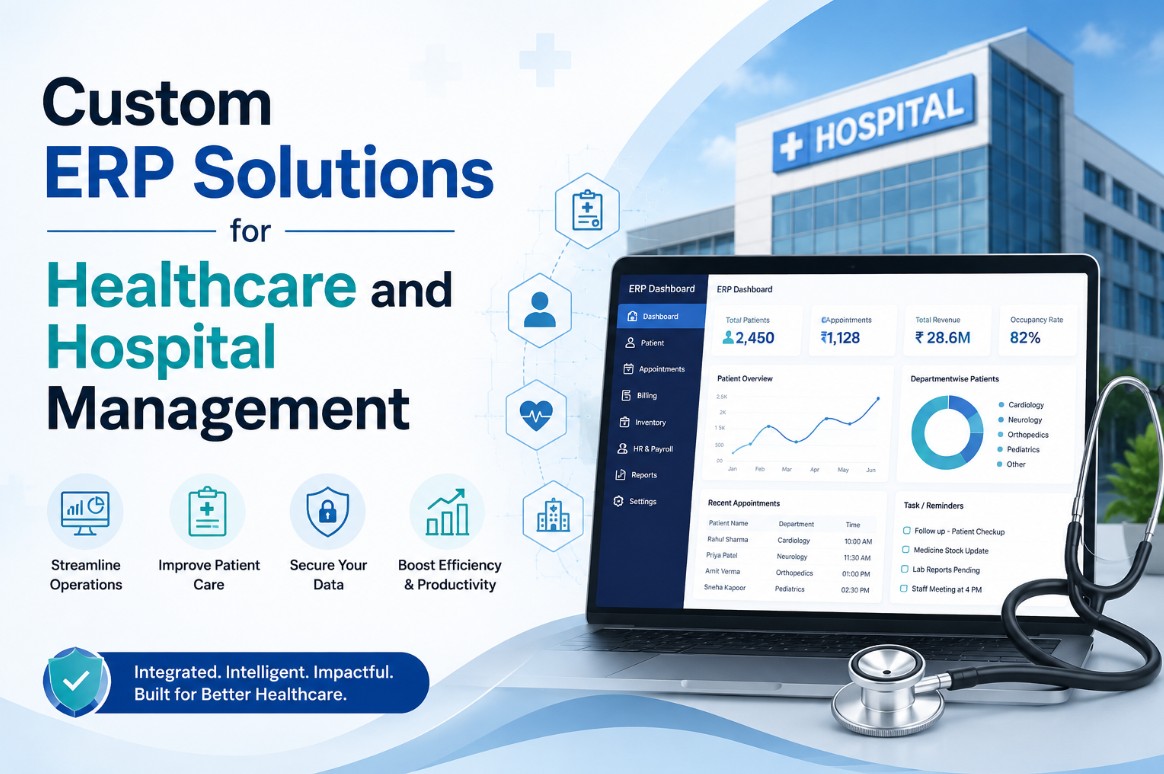
With centralized ERP dashboards, hospitals can track employee profiles, attendance, payroll, shift organization, and even performance reviews. It’s kind of like keeping the workforce details in one neat location.
Laboratory & Diagnostic Management
ERP solutions can also support lab report handling, diagnostic testing flows, and the generation of patient results, usually with fewer bottlenecks and less repetitive work.
Analytics & Reporting
Finally, advanced reporting dashboards deliver live visibility into hospital performance, patient metrics, financial operations, and how resources are actually being used. It’s basically turning raw data into practical insight, so decisions are made quicker and with more clarity.
Benefits of Customized ERP Solutions in Healthcare
Healthcare orgs are kind of leaning more and more into customized ERP systems, because they tend to give better flexibility, growing ability, and daily control than those standard “off the shelf” packages. You know, the usual stuff that doesn’t quite fit
Improved Operational Efficiency
ERP tools can automate a lot of the repetitive administrative duties, so there’s less manual effort, and hospitals can run faster. Overall, hospital productivity usually goes up
Better Patient Experience
When patient data is centralized, and service handling gets quicker, people feel more cared for. It also supports smoother treatment experiences, which tends to lift satisfaction.
Integrated ERP systems can also support healthcare digital marketing efforts by helping organizations manage patient communication, appointment reminders, personalized outreach campaigns, and service engagement more effectively.
Enhanced Data Security
These healthcare ERP systems bring in stronger security features to guard confidential patient information and financial records, keeping them away from unauthorized access
Scalable Infrastructure
A custom ERP platform can expand as the hospital grows, meaning new departments, more services, and changing operational needs are easier to accommodate
Real-Time Decision Making
Analytics dashboards and live reporting support hospital leaders, so they can make operational and financial calls based on what’s happening right now
Regulatory Compliance
ERP systems help healthcare orgs meet industry rules and data handling requirements for health information management, which is a big deal in this space
Role of Custom Enterprise Software Development in Healthcare ERP
Custom enterprise software development lets healthcare organizations build ERP systems that are tailored to the way they actually run day-to-day operations and also to their bigger goals down the road. And honestly, instead of shoehorning everything into a generic package, they can make it fit.
Unlike typical ERP platforms, custom-built healthcare ERP solutions deliver a few things that matter, like personalized workflows and better integration abilities. They also come with more advanced customization options, and yes, improved scalability as the organization grows. On top of that, there’s enhanced security, plus smoother third-party integrations.
So a hospital can connect modules such as telemedicine, AI-driven analytics, patient portals, cloud storage, and IoT-enabled healthcare monitoring directly into their customized ERP solutions and setup.
That flexibility supports future-ready digital ecosystems, which help increase operational efficiency and improve patient care at the same time.
Emerging Technologies in Healthcare ERP Systems
Modern healthcare ERP systems are kind of moving faster now, with advanced tech that helps with automation in healthcare management, and overall day-to-day control. It’s not just about saving time; it’s more like smoother operations across the board.
Artificial Intelligence (AI)
AI-driven ERP setups can handle patient scheduling, predictive analytics, and also healthcare reporting, which boosts operational efficiency too. In practice, it feels like tasks get done with less friction, and insights show up sooner.
Cloud-Based ERP Solutions
With cloud ERP platforms, healthcare organizations can access their data securely from different locations. At the same time, they tend to lower infrastructure expenses, because the hardware headache isn’t as severe.
Internet of Things (IoT)
IoT-enabled healthcare devices can link into ERP systems for real-time patient monitoring and tracking of medical equipment. That connection is pretty important because the information comes in as it happens, not later.
Data Analytics
With advanced analytics, healthcare providers can spot patient trends, judge hospital performance, and evaluate operational efficiency more clearly. Basically, it turns raw numbers into usable signals.
Mobile Accessibility
Mobile ERP apps give doctors, nurses, and administrators the ability to access healthcare data anytime, anywhere. So even on the move, decisions aren’t stuck behind a desk or a terminal.
Challenges in Healthcare ERP Implementation
While ERP systems can bring real benefits for healthcare organizations, they also might stumble into a few implementation hurdles. In practice, things can feel kinda messy at first, you know, because there are multiple moving parts at once.
Some of the more typical difficulties are:
- Data migration complexities, as in moving records and making sure nothing gets quietly lost
- Integration with existing systems, including older platforms and some stubborn interfaces
- Staff training requirements, so teams actually know how to use workflows
- Regulatory compliance management, because documentation and audits do not politely wait
- Initial implementation costs, which can pile up before the “returns” show up
- Cybersecurity risks, since patient data has to stay locked down at every step
Working with a seasoned custom enterprise software development company can help healthcare providers handle these kinds of problems in a more organized, faster way.
Choosing the Right ERP Development Partner
Choosing the right technology partner matters a lot for a successful ERP rollout in healthcare, because if you miss the fit, it’s usually hard to fix later. Businesses should look at a few things, like how much industry history they have, plus the healthcare domain know-how, and not just generic experience. Also, check if they can do meaningful customization, and whether they follow solid security standards, not the “we think it’s secure” kind. Scalability expertise is also key, and let’s not forget post-launch support services, because problems don’t vanish the day go-live happens.
An experienced ERP development company can support healthcare providers in building secure, scalable, and, honestly, feature-rich ERP platforms that match their actual workflows, not some standard template.
Conclusion
Healthcare is moving fast into digital transformation, and customized ERP solutions are turning into a necessity for how modern hospitals run. Patient care and billing are only the beginning; ERP systems also touch inventory management, reporting, and analytics, so day-to-day operations get smoother and healthcare teams can deliver better services.
And since demand for automation keeps increasing, along with the need for centralized healthcare management, investing in custom enterprise software development helps hospitals and providers shape ERP ecosystems that are scalable, secure, and future-ready. As healthcare technology keeps evolving, organizations that adopt tailored ERP solutions can end up with a noticeable advantage, through better efficiency, improved patient experiences, and smarter operational management.


