

For many CDL-A drivers, a truck driving career typically begins as a company role that emphasizes learning assigned routes, safety steps, and freight operation. However, over time, a truck driving career typically begins as a company role on their income, schedules, and long-term financial future. This is the point when owner operator trucking jobs come into the picture as a logical next step. On the other hand, instead of getting a set CPM or salary, owner-operators drive independently as business professionals earning based on load rates, operational efficiency, and the decisions they make.
In contrast to company drivers, owner-operators are the ones who take matters into their own hands and manage pretty much their entire equipment, expenses, and even the business strategy. This entails the inclusion of things like monitoring fuel costs, tracking maintenance schedules, becoming familiar with settlement statements, and planning out routes that maximize their profit. The increased responsibility comes with an attractive salary that ranges much higher along with the empowerment that comes with financial freedom.
Drivers looking at Owner op trucking jobs often make discoveries that the job not only gives them more money in the bank but also the joy of having their own business, and the ability to make the company grow equity. Nonetheless, their success involves proper planning, discipline, and a good carrier partnership.
Table of Contents
Who Owner-Op Is Actually For (Experience Threshold)
Owner-operator trucking is not something given to someone just starting out. The majority of the successful owner-operators have previously spent a couple of years working as company drivers. This kind of experience is what they gain from freight cycles, shipper expectations, maintenance needs, and operational risks before they buy equipment.
Experienced drivers are the ones who can handle the complexities of:
- Trip planning and fuel efficiency
- Understanding load rates and freight demand
- Communication with dispatch and brokers
- Preventive maintenance awareness
- Compliance with DOT and FMCSA regulations
Without such a base, managing operating expenses and negotiating freight becomes very difficult.
Typical experience recommendations:
| Experience Level | Readiness for Owner-Operator | Reason |
| 0–1 year | Not recommended | Limited operational knowledge |
| 2–3 years | Possible with support | Basic understanding of freight operations |
| 3–5 years | Strong candidate | Experience managing routes and schedules |
| 5+ years | Ideal | Full operational awareness and efficiency |
Drivers who comprehend that freight markets change and that the operational decisions they make should be based on the profit per mile are bound to succeed as owner-operators.
In addition to driving skills, owner-operators must also think like business owners. This includes reviewing contract terms, understanding insurance requirements, and tracking operating expenses.
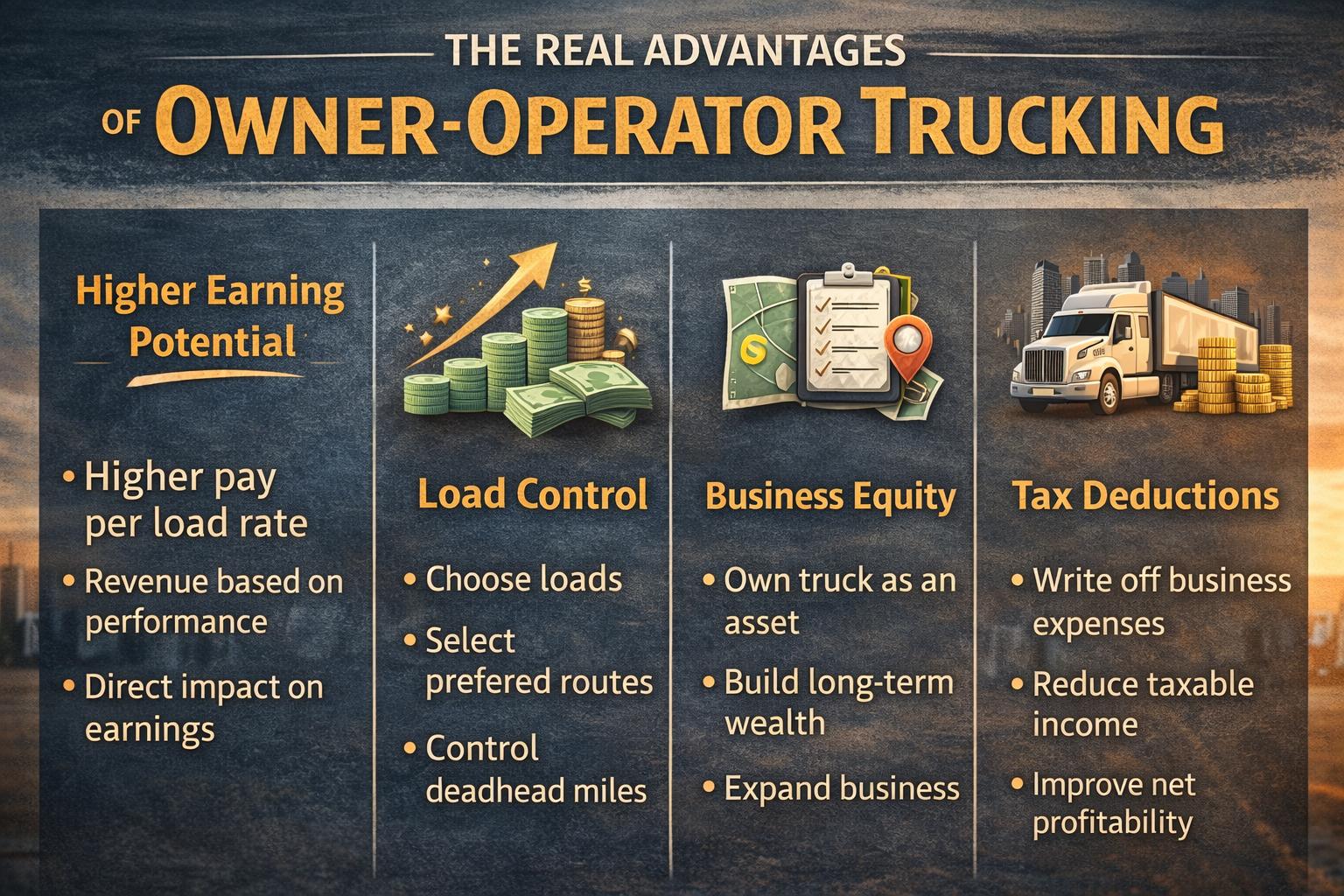
Real Advantages (Control, Earnings Potential, Business Equity)
The main reason behind the shift of experienced drivers from the employee sector to the owner operator section is that they have the financial and operational control. In contrast to fixed mileage rates, which determine the owner’s income even before he/she acquires sufficient experience, owner-operators operate based on load revenue.
The significant advantages feature:
Higher earning potential
Owner operator pay is usually not only much higher than the pay of company drivers, but it also reaches a much higher level when the operator drives effectively. Revenue is influenced by:
- Load rates
- Freight demand
- Cost management
- Fuel efficiency
- Equipment reliability
Example income comparison:
| Driver Type | Average Gross Weekly Revenue |
| Company driver | $1,200 – $1,800 |
| Lease operator | $2,500 – $4,000 |
| Owner-operator | $4,000 – $7,000 |
Owner-operators can still make more money than company drivers in some weeks, even after expenses.
Control over load selection
Owner-operators often get to select their loads, which allows them to prefer:
- Higher paying freight
- Preferred routes
- Home time flexibility
- Lower deadhead miles
This control helps maximize profit per mile.
Business ownership and long-term equity
Owner-operators are either the owners of their trucks or they finance them and this is a business asset. Consequently, they can realize:
- Paid-off equipment
- Increased financial independence
- Opportunity for small fleet expansion
- Long-term wealth building
In contrast to company drivers, owner-operators accumulate business equity.
Tax deductions and financial advantages
Tax deductions allow owner-operators to reduce taxable income and improve net profitability. Owner-operators can write off many business expenses which comprise:
- Fuel
- Maintenance
- Insurance
- Tires
- Equipment purchases
- Office expenses
Tax deductions reduce taxable income and improve overall profitability.
The Real Costs (and How to Plan for Them)
Despite the fact that owner operator trucking jobs provide good earning potential, the running costs are high and must be kept in control. Therefore, misunderstanding these operational costs can be costly if you decide to undergo a transition before understanding them fully.
Main owner-operator expenses are:
| Expense Category | Typical Monthly Cost |
| Fuel | $4,000 – $8,000 |
| Truck payment / lease | $1,500 – $3,000 |
| Insurance | $800 – $2,000 |
| Maintenance reserve | $1,000 – $2,500 |
| Tires | $300 – $800 |
| Permits and registration | $200 – $500 |
The biggest operating expense is fuel which has an overall impact on profitability. With the help of route planning programs, fuel discount programs can lower operating expenses.
Maintenance over time plays an important role. For sure even new trucks will require some maintenance jobs and unforeseen failures can be costly. Experienced owner-operators have emergency repair funds to dodge this threat.
Settlement statements are good tools for monitoring income and expenses. Owner-operators are considered independent contractors, which means they are responsible for their own equipment, fuel, and maintenance expenses, as outlined in the IRS independent contractor determination example: https://www.irs.gov/pub/ss8/09DVC001210.pdf
These statements will include:
- Load revenue
- Fuel deductions
- Escrow payments
- Insurance deductions
- Net income
A clear understanding of settlement statements is beneficial for owner operators in following up on their business performance.
Authority vs leased-on carrier
Authority vs leased-on is one of the most important decisions for new owner-operators.
| Model | Description | Pros | Cons |
| Own authority | Operate independently | Full control, higher potential profit | More paperwork, higher insurance |
| Lease-on carrier | Contract with carrier | Dispatch support, steady freight | Revenue split |
Most new owner-operators begin with a carrier lease to ease their administrative burden and to get easier access to freight.
Financial planning and profit tracking
Proper drivers focus on earning profit on every mile rather than get lost in the concept of gross revenue only. Recording fuel, maintenance, insurance costs, as well as tax and settlement deductions, constitutes a major part of what a professional driver should know about the actual net profit.
For instance, the majority of the experienced drivers would keep a regular percentage of their income on a weekly basis for unforeseen instances such as repairs and taxes which at the end of the day helps in bringing down the stress levels. Owner-operators having a grasp on their finances by serious budgeting plus keeping track of expenses can have the liquidity they need to make it through the slower freight periods.
How to Choose the Right Carrier or Program (Checklist + Red Flags)
Picking out the appropriate lease-on carrier will directly affect your income, workload, and job satisfaction significantly.
Transparent settlement statements
Clear settlements allow drivers to track:
- Revenue
- Deductions
- Escrow balance
Net income
Avoid carriers that provide unclear or inconsistent financial reports.
Strong freight network
Reliable carriers provide consistent freight to minimize downtime. This improves overall earnings stability.
Ask about:
- Average weekly miles
- Freight consistency
- Deadhead percentage
Fuel discount programs
Fuel discounts greatly impact the reduction of the operating costs. Even a small discount will save you tons of dollars.
Maintenance and support programs
Some carriers have a maintenance network or offer discounts, leading to the reduction of repair costs and downtime.
Contract transparency
Carefully review contract terms. Pay attention to:
- Escrow requirements
- Termination policies
- Payment timelines
- Chargeback policies
Red flags to avoid
Avoid carriers that:
- Require excessive escrow deposits
- Provide unclear contracts
- Have poor communication
- Offer inconsistent freight
Selecting the right carrier goes a long way towards ensuring long-term profitability.
Questions to Ask Before You Sign
Before you commit to a lease-on carrier or an owner-operator program, it is important that you dig deep by asking the right questions that will aid in your decision making.
Important questions include:
- What is the average weekly gross revenue?
- What deductions will appear on settlement statements?
- Are fuel discounts provided?
- What insurance coverage is required?
- Is there forced dispatch?
- What are the escrow terms?
- How often are settlements paid?
Example evaluation checklist:
| Question | Why It Matters |
| Average gross revenue | Determines earning potential |
| Fuel discounts | Reduces operating costs |
| Escrow requirements | Affects cash flow |
| Freight consistency | Ensures stable income |
| Contract flexibility | Protects driver independence |
These questions help drivers avoid missing opportunities or making costly mistakes.
FAQs
Q1: How much do owner operator trucking jobs pay?
Ans: Owner operator pay varies greatly due to freight rate fluctuations and costs. Weekly gross revenue mostly goes from $4,000 to $7,000 since net income will rely heavily on fuel, insurance, and maintenance.
Q2: Is leasing on to a carrier better than having your own authority?
Ans: For most drivers who are transitioning from company driving, leasing on to a carrier makes more sense as it provides access to freight, dispatch support, and a lower administrative workload. Own authority requires managing compliance, insurance, and load sourcing independently.
Q3: What is escrow in owner-operator contracts?
Ans: Escrow is a fund set aside by the carrier as a reserve for possible liabilities or interim contract obligations. It is usually returned when the contract period ends.
Q4: What affects profit per mile the most?
Ans: Fuel costs, maintenance efficiency, freight rates, and deadhead miles are the major factors that will affect profit per mile.
Q5: How long should drivers wait before becoming owner-operators?
Ans: Most drivers are better off with at least 3–5 years of driving experience before they go on to owner-operator roles.
Final Thoughts
Owner operator trucking jobs are a great opportunity for experienced drivers to transition from contractor roles to independent professionals. Taking into account all the reasons for this, basically, the high income potential, freedom over business processes and being able to build your own business through owner-operator trucking is one of the best things to do in the sector.

This is not smooth sailing; it is only achievable through planning, financial discipline, and the choice of the right carrier partnership. Drivers who are well-versed in the areas of fuel costs, maintenance planning, settlement statements, and contract terms tend to enjoy stability and growth in their operations.
If you are a skilled and experienced CDL driver who is all set to regulate your own destiny, then the owner-operator trucking configuration stands unparalleled as the independence, earning opportunity, and financial opportunity are paramount.


